Skip to content
  • Home
  • About Us
    • About Us
    • Meet the Team
  • Practice Areas
    • Commercial & Business
      • Commercial & Business Law
      • Business Partnership Disputes
      • Building & Construction Law
    • Family Law
      • Family Law
      • Family Law Involving Business
    • Wills + Estates
      • Wills + Estates Overview
      • Wills + Planning
      • Managing an Estate
      • Will + Estate Disputes
    • Conveyancing
      • Conveyancing + Property Law
      • Conveyancing Quote
      • Real Estate Agents
    • Criminal + Litigation
      • Litigation
      • Criminal + Traffic Law
  • Resources
    • Advice + Articles
    • Free Legal Health Check
    • Legal Fees & Costs
    • Help Choosing a Law Firm
    • 10 Awkward Questions
  • Contact Us
  • Home
  • About Us
    • About Us
    • Meet the Team
  • Practice Areas
    • Commercial & Business
      • Commercial & Business Law
      • Business Partnership Disputes
      • Building & Construction Law
    • Family Law
      • Family Law
      • Family Law Involving Business
    • Wills + Estates
      • Wills + Estates Overview
      • Wills + Planning
      • Managing an Estate
      • Will + Estate Disputes
    • Conveyancing
      • Conveyancing + Property Law
      • Conveyancing Quote
      • Real Estate Agents
    • Criminal + Litigation
      • Litigation
      • Criminal + Traffic Law
  • Resources
    • Advice + Articles
    • Free Legal Health Check
    • Legal Fees & Costs
    • Help Choosing a Law Firm
    • 10 Awkward Questions
  • Contact Us
Advice & Articles

Enduring Powers Of Attorney – Conflict Transactions

  • Published: 8 February 2022
  • Last Updated: 22 May 2024

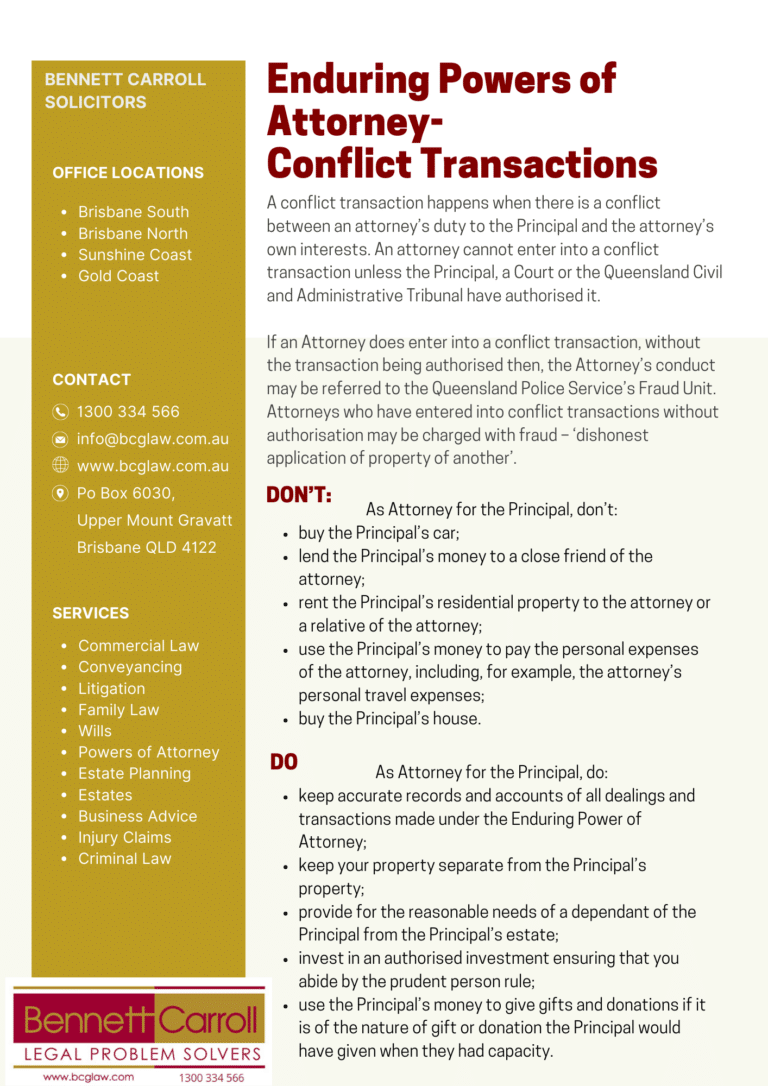
A conflict transaction happens when there is a conflict between an attorney’s duty to the Principal and the attorney’s own interests. An attorney cannot enter into a conflict transaction unless the Principal, a Court or the Queensland Civil and Administrative Tribunal have authorised it.


If an Attorney does enter into a conflict transaction, without the transaction being authorised then, the Attorney’s conduct may be referred to the Queensland Police Service’s Fraud Unit.  Attorneys who have entered into conflict transactions without authorisation may be charged with fraud – ‘dishonest application of property of another’.


DON’T:

As Attorney for the Principal, don’t:

  • buy the Principal’s car;
  • lend the Principal’s money to a close friend of the attorney;
  • rent the Principal’s residential property to the attorneyor a relative of the attorney;
  • use the Principal’s money to pay the personal expenses of the attorney, including, for example, the attorney’s personal travel expenses;
  • buy the Principal’s house.


DO:

As Attorney for the Principal, do:

  • keep accurate records and accounts of all dealings and transactions made under the Enduring Power of Attorney;
  • keep your property separate from the Principal’s property;
  • provide for the reasonable needs of a dependant of the Principal from the Principal’s estate;
  • invest in an authorised investment ensuring that you abide by the prudent person rule;
  • use the Principal’s money to give gifts and donations if it is of the nature of gift or donation the Principal would have given when they had capacity.

Call us on 1300 334 566 or email info@bcglaw.com.au and safeguard your interests every step of the way- We are your legal problem solvers.
Related Articles

Open AI vs Lawyer (Legal Q&A) -

How to make a will & What happens when you’re left out of a will? Open AI Bot vs Real Lawyer (Legal Q&A)

Testamentary Capacity - Contesting Wills

Testamentary Capacity – Contesting Wills

What to Do When a Loved One Dies Without a Will – Expert Legal Guidance from Bennett Carroll Solicitors

Five Considerations when Selecting an Executor to Your Will/ Estate

Five Considerations when Selecting an Executor to Your Will/ Estate

What to Expect When You Are… the Executor of an Estate in Queensland

Contracting Death- What happens if a party in a real estate transaction passes away?

Contracting Death- What happens if a party in a real estate transaction passes away?

This information is provided for general informational purposes only and does not constitute legal advice. Please consult with a qualified lawyer for advice regarding your specific situation.

PrevPreviousBuying a Franchise- Youtube Playlist
NextVideo- Can You Lose Your Deposit When Buying A House? | Your Address Real Estate & Guy GibbonsNext
Serving Clients Across Queensland
Bennett Carroll Solicitors is a proud member of the Queensland Law Society (QLS)

Practice areas

  • Commercial + Business
  • Litigation
  • Family Law
  • Wills + Estates
  • Conveyancing
  • Building + Construction Law
  • Criminal + Traffic

learn more

  • About Us
  • Meet the Team
  • Advice + Articles
  • Contact Us
  • LinkedIn
  • Instagram
  • Facebook

Our Office Locations in SEQ - click to view

  • Brisbane North - Stafford
  • Brisbane South - Upper Mount Gravatt
  • Sunshine Coast - Kawana Waters
  • Gold Coast - Mermaid Beach
  • Ipswich- By Appointment Only
  • Brisbane Central- By Appointment Only

Get In Touch

  • 1300 334 566
  • Click to Email
  • 8.30am - 5pm Monday - Friday
  • Chat With Us (Bottom of this page)
  • Bennett Carroll Solicitors
  • 1300 334 566
Copyright 2025 © Bennett Carroll. All rights reserved.